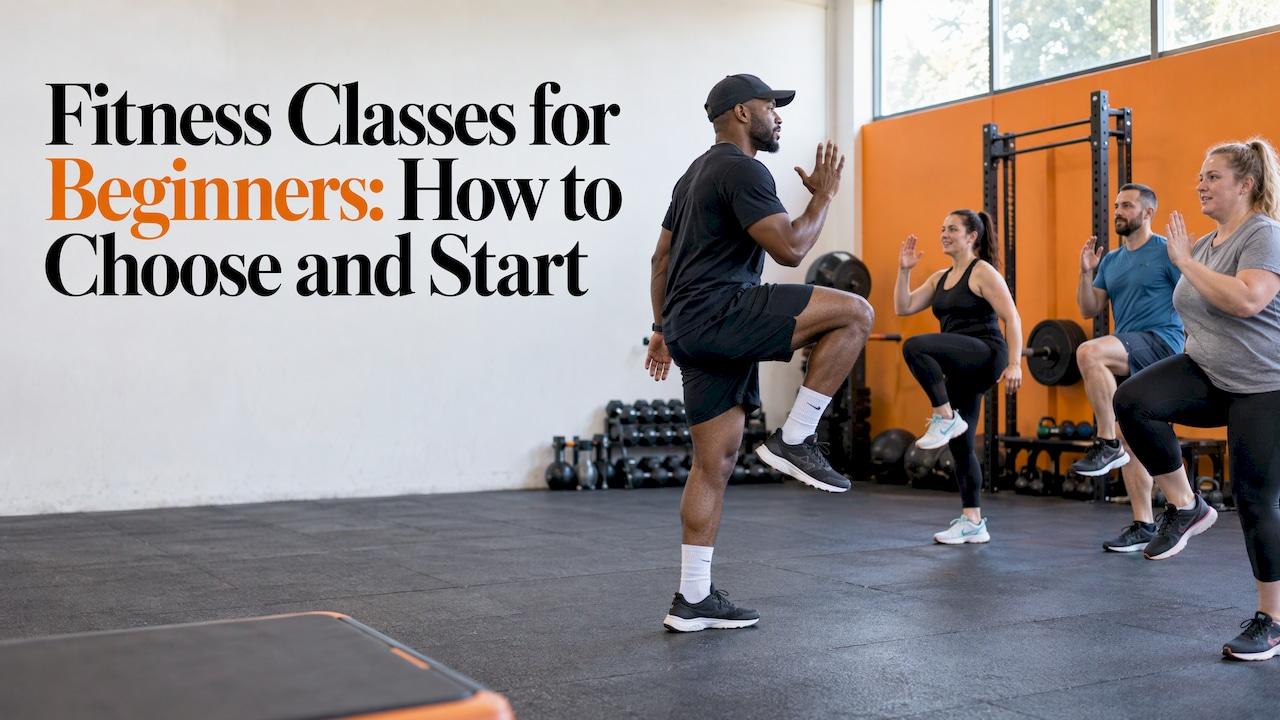
The best fitness class for a beginner is one where nobody expects you to know anything already. You can turn up with no experience, work at your own level and be welcomed by people who remember their own first session. This guide explains how to spot that kind of class, which types are easiest to start with, what happens on your first visit and how to build up without overdoing it. We run free and paid community sessions in Milton Keynes, so we also say where that fits.
TL;DR
- A genuinely beginner-friendly class has clear information before you join, instructors trained to work with different abilities, and a culture that does not tolerate put-downs.
- Cardio, strength, balance and circuit-style classes are all sensible places to start, and you do not have to keep up straight away.
- Start small and build gradually. Adults in England are advised to aim for at least 150 minutes of moderate activity a week, but any activity beats none.
- Group classes can help your mood and social life as well as your fitness, which is often what keeps people coming back.
- In Milton Keynes, NLB runs run club, boxing and lifting sessions, including free weekly ones, where every fitness level is welcome.
Table of Contents
- What makes a fitness class beginner-friendly
- Types of fitness class beginners can try
- How to tell whether a class suits you
- What to expect and what to bring to your first class
- Starting safely and building up over time
- Why group classes help your mood and confidence
- Our view on what beginners need
- Try a beginner-friendly session with NLB in Milton Keynes
- Frequently asked questions
- Sources
What makes a fitness class beginner-friendly
A label saying "all levels" is a start, but it is not enough. What matters is how the class is set up and how it feels once you are in the room. UK activity-sector guidance from Energise Me suggests that good providers consider free tasters or discounts, flexible payment options, wheelchair-accessible venues, simple information before you join, beginner or adapted sessions and clear promotional materials.
Use that as a checklist when you look at any class:
- Clear information beforehand. Can you find out where it is, how long it lasts, what to wear and what the session involves without having to ask?
- A low-pressure way in. A free session or a taster means you can try it before committing money.
- Flexible options. Different ways to pay and different ways to do each move help people with very different starting points.
- Confident instructors. The same guidance says coaches should be trained and confident in working with people of different abilities.
- A kind room. Energise Me also advises providers to challenge hurtful banter or negative language, so newcomers feel safe. If a class tolerates sniggering at beginners, it is not beginner-friendly, whatever the poster says.
You do not need previous experience for any of this. A class that requires it is simply not a beginners' class.
Types of fitness class beginners can try
There is no single right choice. Pick the type that sounds like something you might enjoy, because the class you actually attend beats the perfect one you skip.
Cardio classes
Cardio classes use short bursts of movement to build your cardio fitness, according to the UK health resource Moving Medicine. The same page notes you do not have to keep up at first and that you will learn as you go. Running is the simplest example: a beginner run group lets you mix walking and running at your own pace.
Strength classes
Strength classes work the whole body to build strength in your arms, legs and core. That includes lifting sessions in which you start with light weights and learn the movement patterns before adding load. The National Axial Spondyloarthritis Society describes Body Pump as a low-impact class with set movements while holding weights, which makes it a structured way to start.
Balance and gentle flow classes
Balance classes combine arm and leg movements. For something calmer, the same society describes Body Balance as low impact, drawing on yoga, Pilates and Tai Chi, with breathing control, stretches and gentle flowing movements to improve flexibility and strength. If you are returning to exercise after a long break, this style is a comfortable first step.
Circuit training
Circuits move you through a series of stations. According to the NASS description, you work at your own pace and get a full-body workout. This is one of the easiest formats to scale: two people at the same station can do easier or harder versions of the same exercise.
HIIT
High-intensity interval training is described by NASS as short bursts of movement with small rest periods. Exercises can be standing or seated and can be adapted. It sounds intimidating, but in a well-run class the intensity is yours to set.
Boxing-style sessions
Boxing fitness classes teach basic stances and punches, then build them into pad work and conditioning. Nobody is asked to spar. They suit people who want a workout that feels purposeful and a good way to let off steam.
| Class type | What you do | Good if you want |
|---|---|---|
| Cardio or run group | Short bursts of movement, or run and walk intervals | To build stamina at your own pace |
| Strength or lifting | Whole-body strength work with set movements | To get stronger and learn technique |
| Body Balance style | Gentle flowing moves with breathing and stretches | A calm, low-impact start |
| Circuits | Stations worked at your own pace | Variety and easy scaling |
| Boxing fitness | Stances, punches and conditioning | An energetic session with a clear skill to learn |
How to tell whether a class suits you
Suitability comes down to three things: your fitness level, your health and your access needs.

Fitness level. Look for words like "beginner", "introductory" or "no experience needed", and check whether the instructor offers easier and harder versions of each move. Inclusion guidance from Project Enhance, a US resource, separates two ideas that are worth knowing. Modifications change the content and skills expected. Adaptations change the environment, equipment or how a task is done, without changing the integrity of the programme. A good instructor uses both without making a fuss.
Adaptations for your body. The same guide says adaptations can include supportive equipment and changing how movements are performed, so people with limited dexterity, strength, balance or posture control can take part safely. If you need something like that, ask the organiser before your first session. A good one will be glad you did.
Health conditions. If you live with a long-term condition, the right class depends on it. For example, NASS says people with axial spondyloarthritis may find low-impact classes less likely to lead to a flare, and advises always starting with a beginners' class. If you have a heart or lung condition, or you are unsure whether you should exercise at all, speak to your GP or specialist nurse before you start, and follow the plan they give you.
Access. Check the venue for step-free entry, toilets and changing space, and whether the session can be done seated if you need that. Energise Me lists wheelchair-accessible venues as part of good practice, so it is reasonable to expect a clear answer.
What to expect and what to bring to your first class
Feeling nervous is normal. Moving Medicine says it is completely normal to feel unsure when going to a gym, that everyone starts somewhere, and that many gyms offer beginner-friendly classes or groups where everyone is learning together. Its advice on starting at the gym includes bringing a family member or friend to help build your confidence.
A typical first session goes like this:
- Arrive a few minutes early. Introduce yourself to the instructor and mention anything they should know, such as an old injury or that it is your first time.
- Warm up. Expect gentle movement that raises your heart rate gradually.
- Main workout. The instructor demonstrates each move. Copy what you can and rest when you need to.
- Cool down. Slower movement and stretching to finish.
- Chat afterwards. In a community class this is often the best part.
What to bring:
- A bottle of water
- Comfortable clothes you can move in
- Supportive trainers (for outdoor sessions, something suitable for the weather)
- A small towel
- A friend, if that helps
You do not need special kit, a gym membership or a particular level of fitness.
Starting safely and building up over time
The golden rule from Moving Medicine is to start at a comfortable level and build gradually, rather than going too hard too soon. GOV.UK guidance for England says the same: start small, build up, and remember that any physical activity is better than none. For adults, it advises aiming for at least 150 minutes of moderate activity a week, in bouts of 10 minutes or more, with muscle-strengthening activity on at least 2 days a week.
That is a destination, not a first-week target. One class a week is a very good start. Here is a simple way to progress:
- Weeks 1 to 2: one class a week, working at an effort where you could still hold a conversation.
- Weeks 3 to 4: add a short walk or a second session if you feel good.
- After a month: try a different type, such as adding a strength session to a run group, so you cover both cardio and muscle-strengthening.
Warm up and cool down
Do not skip either. NHS cardiac rehabilitation guidance from University Hospitals Sussex describes warm-up and cool-down as important parts of every session, and gives about 10 to 15 minutes for the warm-up to prepare the heart and body, building up slowly so your heart rate rises gradually. Although written for people with heart conditions, the principle of a gradual start applies to anyone new to exercise.
Listen to your body
NHS patient information from the Royal Brompton and Harefield hospitals recommends exercising at the right level for you, building up slowly and listening to your body. It also says not to do any exercise that makes you strain and hold your breath as your muscles contract. That advice is for people with pulmonary hypertension, so follow your own clinical team's plan if you have the condition. For everyone else, breathing steadily through each rep is a good habit to learn early.
If you feel chest pain, dizziness or unusual breathlessness, stop and get medical advice.
Why group classes help your mood and confidence
People often start for fitness and stay for the people. The research backs this up. A qualitative study of a yoga on social prescription programme found that attending created social connectedness, with participants describing a community feel and a bonding experience. An evaluation of an exercise referral scheme in England reported perceived benefits beyond physical health, including social and personal-emotional improvements, along with community spirit and camaraderie.
A 2025 social value summary of group exercise links the shared nature of group exercise with socialisation and human connection, and with mental wellbeing factors such as loneliness and self-efficacy. And a 12-month UK economic evaluation of community-led organisations reported statistically significant improvement in social connectedness and mental wellbeing among participants.
The practical lesson: a regular group gives you a reason to turn up, people who notice when you are not there, and a ready-made set of friendly faces. That is why consistency is easier in a community than alone at home.
Our view on what beginners need
We started Nobody Left Behind because we saw how many people want to get active and never make it through the door. It is rarely about motivation. It is about walking into a room where you do not know anyone and feeling that you do not belong.
So we built everything around one idea: each new person should be recognised and included, whatever their fitness level. We run run clubs, boxing sessions and lifting workouts, and we offer a variety of free weekly sessions so that cost is never the first barrier.
We think the social side is not a bonus. It is the thing that makes people come back for a second week, then a third. Friendships turn a one-off class into a habit, and member perks from local businesses mean the community reaches beyond the session itself.
If you are nervous, that is fine. Most of us were too. Come along, say hello, and go at your own pace.
Kola
Try a beginner-friendly session with NLB in Milton Keynes
If you live in or near Milton Keynes, we would love to see you. Nobody Left Behind organises run clubs, boxing sessions and lifting workouts, with a variety of free weekly sessions and paid sessions, events and memberships. Everyone is welcome, whatever their fitness level, and you can book sessions and track your progress in our app.

Members also get perks from local businesses, so the benefits go beyond the workout. To see what is on and pick a first session, head to the NLB Milton Keynes community fitness page.
Frequently asked questions
Do I need experience to join a beginners' fitness class?
No. A real beginners' class assumes you are starting from zero and shows each move before you do it. Moving Medicine notes that many gyms and groups run classes where everyone is learning together. If a class asks for previous experience, look for a different one.
How often should a beginner go to classes?
Start with one a week and build up as it feels comfortable. GOV.UK advises starting small and building gradually, with an eventual aim for adults of at least 150 minutes of moderate activity a week plus muscle-strengthening on at least 2 days. Rest between sessions is part of the process.
What if I am the least fit person in the room?
You almost certainly are not, and even if you were, a good class is built for that. Instructors should be confident working with different abilities, and moves can be scaled by changing the equipment, the range or the pace. Tell the instructor it is your first time and they will help.
Are free classes any good for beginners?
Yes, because they remove the financial risk of trying something new. Energise Me lists free tasters and discounts as ways of making sessions more inclusive. At NLB, our free weekly sessions are open to all levels, and you can add paid sessions or membership later if you want more.
Can exercising in a group really help my mental health?
Research on group and community exercise in England and the UK links it with better social connectedness and mental wellbeing, and with a sense of camaraderie. It is not a treatment for any condition. If you are struggling with your mental health, speak to your GP as well.
Sources
- Inclusive physical activity: making your sessions inclusive, Energise Me
- Cardio classes, Moving Medicine
- Gym, Moving Medicine
- Exercise classes, National Axial Spondyloarthritis Society
- Inclusion Guide, Project Enhance
- Health matters: getting every adult active every day, GOV.UK
- Cardiac rehabilitation: exercise for heart health, University Hospitals Sussex NHS
- Exercise advice for people with pulmonary hypertension, Royal Brompton and Harefield
- Joining a group was inspiring: a qualitative study of yoga on social prescription
- Participant experiences of an exercise referral scheme in England
- Social Value of Group Exercise, executive summary
- Economic evaluation of participation in community-led organisations, University of Stirling