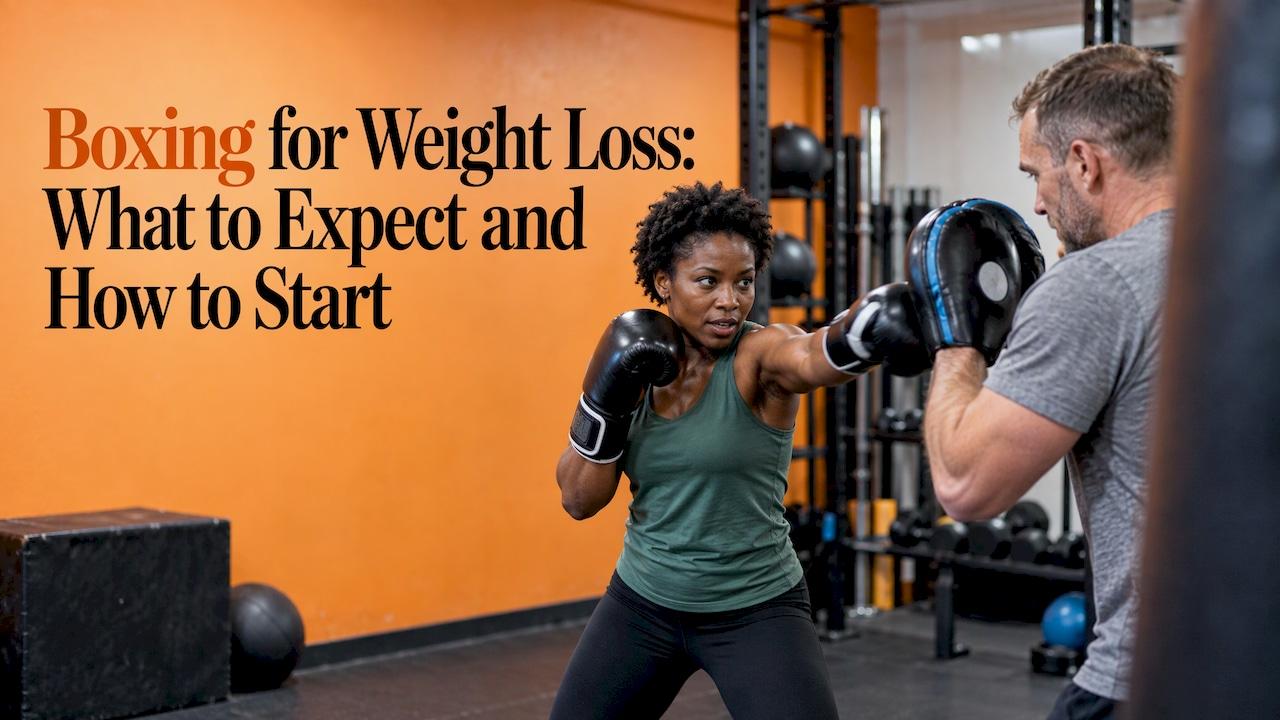
Boxing can help you lose weight, as long as you do it regularly and pair it with eating a little less than your body uses. It is hard, varied cardio that works your whole body, and it is also one of the easier workouts to keep turning up for when you train with other people. Below: what the evidence says, what results are realistic, how often to train, and how to start safely if you have not exercised for a while.
TL;DR
- Boxing raises your heart rate and works legs, core and upper body, but weight loss still depends on using more energy than you eat and drink, as the NHS explains.
- A realistic aim is 0.5 to 1 kg (1 to 2 lb) a week, not a dramatic drop.
- Group training helps: a NIHR review found group programmes led to greater weight loss than going it alone.
- Beginners should build up gradually. Consistency beats intensity in the first weeks.
- In Milton Keynes, our community boxing sessions welcome every fitness level.
Table of Contents
- Do you lose weight with boxing?
- What the research says about boxing training
- How the boxing session was structured
- Realistic results: how much weight can you lose?
- How often should you box to lose weight?
- Why group workouts help you stick with it
- Starting boxing as a beginner
- Eating for boxing and weight loss
- Try a boxing session with us in Milton Keynes
- FAQ
- Sources
Do you lose weight with boxing?
Yes, boxing can contribute to weight loss, but not on its own. The NHS advice for adults is to aim to lose 1 to 2 lb (0.5 to 1 kg) a week by being active and by eating and drinking fewer calories than your body uses. On average, it puts that at around 2,000 calories a day for women and 2,500 for men.
Boxing helps with the activity side of that equation. According to Moving Medicine, boxing can help maintain a healthy weight, build muscle tone and improve overall fitness. It also supports heart health, balance and coordination, and it can lift your mood through what the guide calls a "moving meditation" effect.
It is worth being straight about numbers. Many websites claim a boxing hour burns 600 to 1,000 calories. The real figure depends on your body weight, how hard you work and how much of the hour is actual work rather than standing and listening. A heavier person working at a hard pace burns more than a lighter person pottering through drills. Treat any promised figure as an estimate, and judge progress by how your clothes fit, your waist, your energy and your consistency, not by a calorie counter on a watch.
The European Association for the Study of Obesity (EASO) notes that exercise may improve eating behaviours and satiety, though it may also raise hunger before meals. Practically, that means planning something filling to eat after you train, so a tough session is not followed by a big snack run.

What the research says about boxing training
The most useful study here is a 2015 pilot trial from Australia in 12 adults with abdominal obesity. They trained in supervised boxing sessions of 50 minutes, four times a week, for 12 weeks. By the end the group had:
- a 13.2% reduction in body fat percentage
- a 5.3% reduction in waist circumference
- a 4.1% reduction in body mass
- a 4.0% reduction in BMI
The sample was small and the authors say larger, well-designed trials are needed. They concluded that boxing-style interval training was feasible and may bring a better effect on obesity and heart health than the same amount of brisk walking. That is encouraging rather than conclusive, and four sessions a week is a lot for a beginner.
The finding that matters most to anyone starting out is about showing up. The boxing group attended 79% of sessions, against 55% in the walking group, and nobody dropped out of the boxing group, while two walkers did. The best workout for weight loss is the one you keep doing.

How the boxing session was structured
The same study used 2-minute hard intervals followed by 1-minute rest, aiming for a perceived effort of 15 to 17 out of 20 ("hard" to "very hard"). That is similar to how a boxing class feels: rounds of pad work, bag work or shadow boxing, then a short breather. You do not need to start at that level. Beginners should work at a pace where they can feel their breathing rise but still manage a few words.
EASO advises that high-intensity interval training should only be recommended after a proper assessment of cardiovascular risk and under supervision. If you have a heart condition, high blood pressure, are pregnant or have not been active for years, talk to your GP before joining hard sessions, and tell the coach about it on your first night.
Realistic results: how much weight can you lose?
EASO's 2021 synthesis says the expected weight loss from exercise alone is, on average, not more than 2 to 3 kg. Exercise alone rarely does the heavy lifting. Combined with changes to what you eat, results are better. In the UK's FFIT programme, which paired physical activity with lifestyle support for men, the 12-week mean weight loss was 5.04 kg, with a 6.8 cm reduction in waist circumference.
On pace, England Boxing's weight management guidance says around 1 kg a week is the most any athlete should aim for, and 0.5 kg a week is safer and more sustainable. That lines up with the NHS range above. Its coaching handbook also asks people to think about body fat rather than just scale weight, and says dehydrating yourself to drop weight is not acceptable. Skip sweat suits and crash diets: they cost you energy for training and put health at risk.
A sensible expectation for a beginner who trains two or three times a week and tidies up their eating:
| Timeframe | What to expect |
|---|---|
| First 2 to 4 weeks | Better stamina, better sleep for many people, technique starting to click. Scale may barely move. |
| 1 to 3 months | Clothes fit differently, waist measurement drops, sessions feel easier. |
| 3 months and beyond | Steady loss in line with 0.5 to 1 kg a week if your eating supports it, plus visible muscle tone. |
This is a guide, not a promise. Bodies differ, and so do starting points, sleep, stress and medication.
How often should you box to lose weight?
The published targets are about total weekly activity, not boxing alone:
- EASO recommends 150 to 200 minutes a week of aerobic exercise, at least at moderate intensity, for weight and fat loss.
- NICE says that to prevent obesity most people may need 45 to 60 minutes of moderate activity a day, more if they have not cut their calorie intake, and that people who have lost weight may need 60 to 90 minutes a day to avoid regaining it.
- For keeping weight off afterwards, EASO suggests 200 to 300 minutes a week.
None of that means eight hours in a boxing gym. Walks, cycling and everyday movement count towards the total, and the NHS says activity can be broken into shorter chunks. A workable pattern for a beginner:
- One or two boxing sessions a week to start, so your shoulders, calves and hands adapt.
- A run, brisk walk or lifting session on other days to build the weekly total.
- At least one rest day, because progress comes from recovering.
- Build up gradually. EASO advises inactive adults to increase exercise volume step by step, because injury and cardiac risks are highest when someone unaccustomed to activity suddenly does too much.
Why group workouts help you stick with it
Weight loss is a months-long project, and motivation fades. This is where groups earn their place. A 2018 NIHR review of 47 trials with 10,703 participants found that group-based diet and exercise programmes produced average weight loss of 3.5 kg more than comparison groups at six months, 3.4 kg at 12 months and 2.6 kg at 24 months. Programmes did better when they targeted weight loss, gave feedback and set specific goals.
Research cited by EMD UK points the same way: the group element is linked to better adherence, fewer dropouts and a stronger sense of belonging. It also reports that over 10.6 million adults in England use group exercise as part of their routine.
What to look for in a group session:
- A welcome for all levels, so you are not left behind in the first round.
- Regular sessions, at least weekly. NICE's weight management guidance recommends programmes of at least three months with weekly or fortnightly contact.
- Qualified instructors. The same guidance expects instructors to be registered with the Register of Exercise Professionals (or equivalent) at level 3 or above for structured weight management programmes.
- A coach who asks about injuries and health. England Boxing's handbook says coaching assistants must keep participants safe, run risk assessments and record medical status and injuries.
Starting boxing as a beginner
Boxing can look intimidating. The 2015 study authors even suggest it is perceived as a high-risk activity, which slowed their recruitment, yet they recorded no serious adverse events in the boxing group. Fitness boxing classes focus on bag and pad work and conditioning, not on getting hit.
Your first month, in practice:
- Tell the coach about injuries, health conditions or worries before you begin.
- Wear trainers with grip, light clothes and bring water. Gloves and wraps are usually the only extra kit.
- Learn the basics first: stance, jab, cross, then hooks. Speed and power come later.
- Pace yourself in the rounds. Hard but controlled beats flat out for 30 seconds then gasping.
- Eat sensibly around sessions and keep fluids up, without trying to dehydrate yourself.
- Book your next session before you leave. Routine is what carries you through weeks three to six.
Adding strength work helps too. Lifting builds muscle that supports your joints and punching posture, and it fits neatly alongside boxing and running in a weekly plan.
Eating for boxing and weight loss
The calorie balance is where most of the result comes from. The NHS suggests eating and drinking fewer calories than you use rather than cutting out entire food groups. Simple steps that work alongside training:
- Keep protein and vegetables in most meals so you feel full.
- Swap sugary drinks for water or unsweetened options.
- Plan a proper meal after training so you do not graze.
- Avoid skipping meals before a session. You need the energy to work hard.
If you have a medical condition, take medication or are considering a larger change in how you eat, speak to your GP or a registered dietitian first.
Perspective
We started Nobody Left Behind because we saw how many people in Milton Keynes wanted to get fit but dropped out of programmes after a few weeks. The problem was rarely willpower. It was feeling out of place, not knowing anyone, and not having sessions that were easy to turn up to.
That is why we run boxing, run club and lifting sessions where every fitness level is welcome, and why we make a point of recognising each new face. When you know someone will notice if you are missing, you come back. Coming back is what actually moves your weight, your strength and your mood over months.
Our view is simple: the best boxing plan for weight loss is the one you enjoy enough to repeat. Free weekly sessions lower the barrier to starting, and perks from local businesses make the habit feel like part of life in the city. The scale is one measure. Friendships, confidence and feeling better after a session count too.
Kola
Try a boxing session with us in Milton Keynes
Nobody Left Behind is a community fitness initiative in Milton Keynes. We run run clubs, boxing sessions and lifting workouts, with a range of free weekly sessions plus paid sessions, events and membership. Members also get perks from local businesses, and you can book and track sessions in our app. Whatever your starting point, you will be welcomed.

See what is on and how to get started at Nobody Left Behind in Milton Keynes.
FAQ
Do you lose weight when you do boxing?
Yes, boxing can support weight loss when you do it regularly and eat fewer calories than your body uses. Exercise alone typically produces modest loss, on average no more than 2 to 3 kg according to EASO. Combined with sensible eating, a pace of 0.5 to 1 kg a week is a healthy aim.
Is it possible to lose 10 pounds in a month?
It is possible for some people, but it is faster than the NHS range of 1 to 2 lb a week, which gives about 4 to 8 lb a month. Faster loss often comes from crash dieting or fluid loss, which England Boxing says puts health and performance at risk. Talk to your GP if you want to lose weight faster.
How many times a week should I box to lose weight?
Start with one or two sessions and build up. Alongside other activity, aim towards the 150 to 200 minutes a week recommended for weight and fat loss. Leave at least one rest day each week.
Can group workouts help you lose weight?
Yes. A NIHR review found group-based programmes led to greater weight loss than comparison groups up to 24 months later. Groups also tend to improve attendance, which is the biggest factor in results.
Do I need experience to join a boxing class?
No. Beginner-friendly sessions teach stance and basic punches from scratch. At our Milton Keynes sessions all fitness levels are welcome, and you can tell the coach about any injuries or health concerns when you arrive.
Sources
- Overweight and obesity in adults, NHS
- Boxing, Moving Medicine
- Exercise training in the management of overweight and obesity, EASO 2021
- The feasibility and effectiveness of high-intensity boxing training, 2015
- FFIT scale-up and scale-out study, 2020
- Weight management guidance, England Boxing
- Boxing coaching handbook, England Boxing
- Physical activity and diet, NICE NG246
- Group-based diet and exercise programmes, NIHR
- Weight management: lifestyle services, NICE 2014
- EMD UK on group exercise and health